
Everything is Grief, Everything is Love
Notes on remembering and cracking open

I start a new job in a restaurant down a laneway in the city.

And on my second week, I am so caught up in the rush and bustle of the work; in the mental hurdle of adapting quickly to unfamiliar terrain; in the focus needed to perform socially, as is required in this kind of work; and the attentiveness required in it also — I am so caught up in all of this, my brain so preoccupied, that the anniversary of Her death passes by me without any recognition. I slip into the sixth year, without noticing — without remembrance, or reflection, or mourning, or even acknowledgement.
The day passes by, without prayer.

So far I am, now, from the remembering.

But a couple days later, it occurs to me, as I prepare my breakfast at work, that while I may be further from the grief of Her — from the ache of Her absence — this does not necessarily mean I am all that far from Her.

On the dawn of the sixth year, during my break at work, I ate jam and sliced banana on toast for breakfast, just as She used to — as we used to, together, at Her dining table.

Even this, too, a prayer.
A ritual.
An act of remembering — even if an unconscious kind.
Like habit. Like muscle memory.

Remembering Her is an act of muscle memory.

I remember Her like I breathe — instinctually, and without effort.
Unconsciously.
Perpetually.

...

I start a new job in a restaurant down a laneway in the city, and
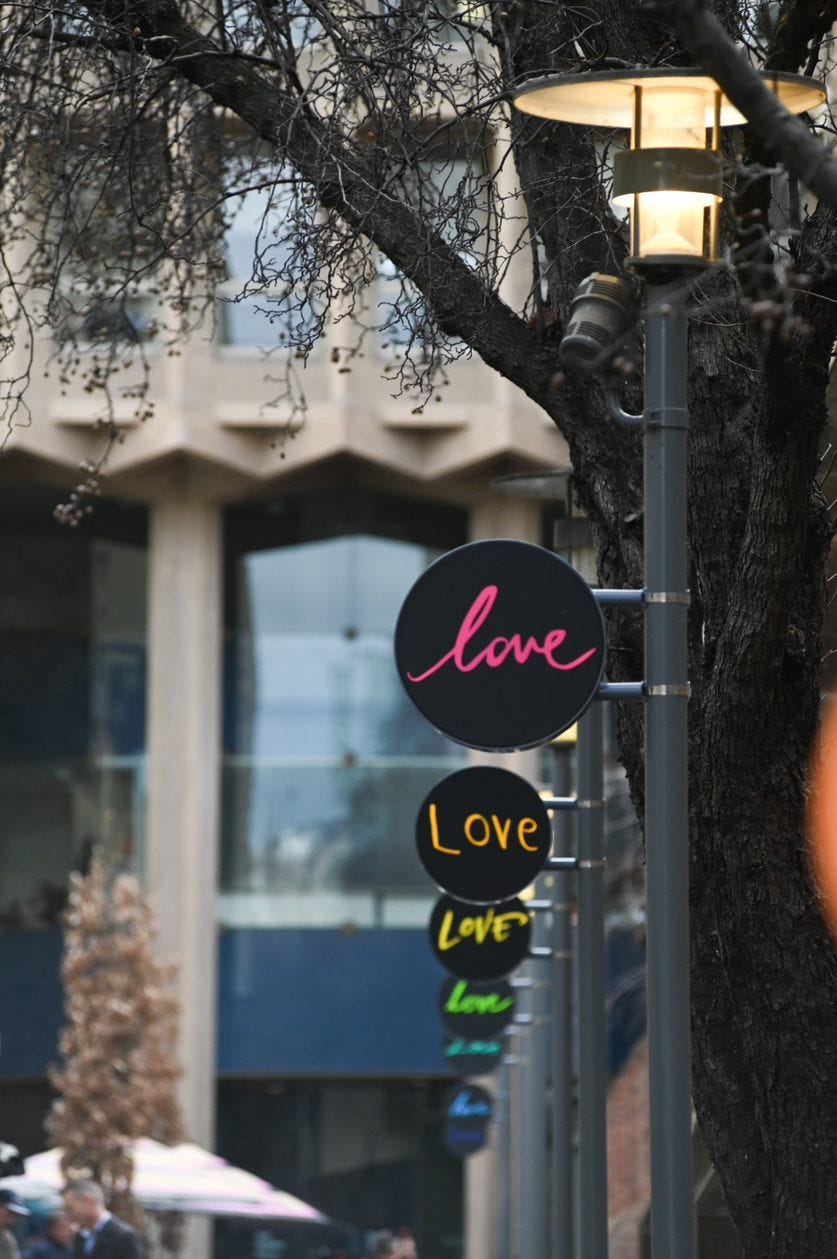
hanging out from each lamppost down that lane are circular signs that say
love
in different fonts and neon rainbow colours.

It is still dark each morning when I arrive for my shift — and so, my path is illuminated by the lampposts and these glowing letters — love,
every twelve steps:

love
           love
                      love
                                 love
                                             love.

I think of these signs like utterances — each step, another prayer:

love
           love
                      love.

Or I think of them like a roll call for everyone I love, like I could take attendance as I walk to work in the morning:

"Love?"
                      "Here!"

           "And... love?"
                                           "Here!"

Like I am calling into presence everyone I love, and everyone I have ever loved.
Like I am carrying them with me.

There is a clip of Maya Angelou I stumbled upon a while ago, and have thought about quite often since, in which she says:
“One of the things I do, when I step up on the stage, (…) I bring everyone who has ever been kind to me with me. Black, white, Asian, Spanish-speaking, Native American, gay, straight — everybody. I say: “Come with me. I’m going on the stage, come with me. I need you now.” Long dead. You see? So, I don’t ever feel I have no help. I’ve had rainbows in my clouds.”
Or, I think of these signs like speed signs — I walk at love kilometres per hour.

How fast, do you think, is love km/h?

And what happens if I exceed the speed limit?

Will a police car pull me over and say:
"Sir, do you have any idea how fast you were loving?
You need to slow down."

"But officer, I love you!", I'll say. "I am in love with it all!"

...

Last week, I was feeling particularly sensitive. Tender. Soft to the touch. Reckoning with feelings of longing, and self-doubt, and shame. A deep sadness that kept bubbling to the surface.

And for three days in a row last week, I had interactions with strangers at work that devastated me. That cracked me open.

On Tuesday, a middle-aged woman comes in after the lunch rush looking for a table, and tells me she’s just been to her partner’s funeral. A group of about fifteen funeral-attendees sit with her, spread across two of the outdoor tables, with wine and beer and coffee. She orders the steak, and when I place it in front of her she asks for a side of butter — “it was our tradition”, she announces.
Even this, too, a prayer.

On Wednesday, late-morning, a fifty-something couple come in for breakfast.
Earlier, during my break, I had listened to a voice note from a friend, updating me on another friend's health, and I ate my breakfast as I ached for them, for the grief they are moving through — of having to readjust to living with chronic illness.

The couple orders their breakfast. He, the crab scrambled eggs; she, the smashed avocado. On a whim, while refilling their water glasses, I ask how their morning has been so far — which opens the floodgates to a sensitive anecdote the man shares with me.
"We've just come straight here from the hospital", he says. "Don't worry, it's good news."
He goes on to tell me how this morning they were given the results — following months of MRI scans and medical anxiety — and that the lesion on his brain is benign, and most likely has been present since birth.

“I was just saying to my wife”, he tells me, “I sat down just now, and I went—”, and he lets out a deep sigh. “I think I just exhaled for the first time in six months.”

For the next half-hour, I move about having to hold back tears in between checking on my tables. At one point, I glance over at them from behind the bar — both of them squeezed side by side onto the one-seat booth of their small, two-person table; the empty chair opposite them still tucked in; her head resting on his shoulder as her eyes water gently.

And then, on Thursday, I serve a retired couple having lunch to celebrate their fifty-fourth wedding anniversary. I ask them if they ever get asked what the secret to a successful marriage is — and framing the question like this, I know, only slightly absolves me of the cliché, but it’s been a sensitive week already and I’m something of a junkie for sentimentality, so why not aim for a home run?

She says, simply, yet with such intention and sincerity in her voice: “You give more than you get.”

Strrrrike three! I’m outta here!
I am cracked open.

Open and open and open — my whole body just one open wound, tender, soft to the touch, until everything brings me to tears, until I am so in love with it all.

Until every step I take is love.

love
           love
                      love
                                 love
                                             love.

A funeral, a hospital visit, a wedding anniversary —

love
           love
                      love.

An empty chair.

Steak with butter.

Sliced banana and jam on toast.

love
           love
                      love
                                 love
                                             love.

I'm going now, come with me.

I love you. I need you.
The love signs are part of an art installation, titled Street of Love, by Heidi Kenyon, based on Paul Kelly's songs. Kenyon writes: "My artwork features lyrics from Paul Kelly songs that can be made complete by the word love, and employs the moon as a metaphor for its shapeshifting form. It responds to the rich character of the laneway, and asks passers-by to look up and bring their own stories to these heavenly bodies.”